Featured Products
A little porcelain-inspired garden you can set a drink on.
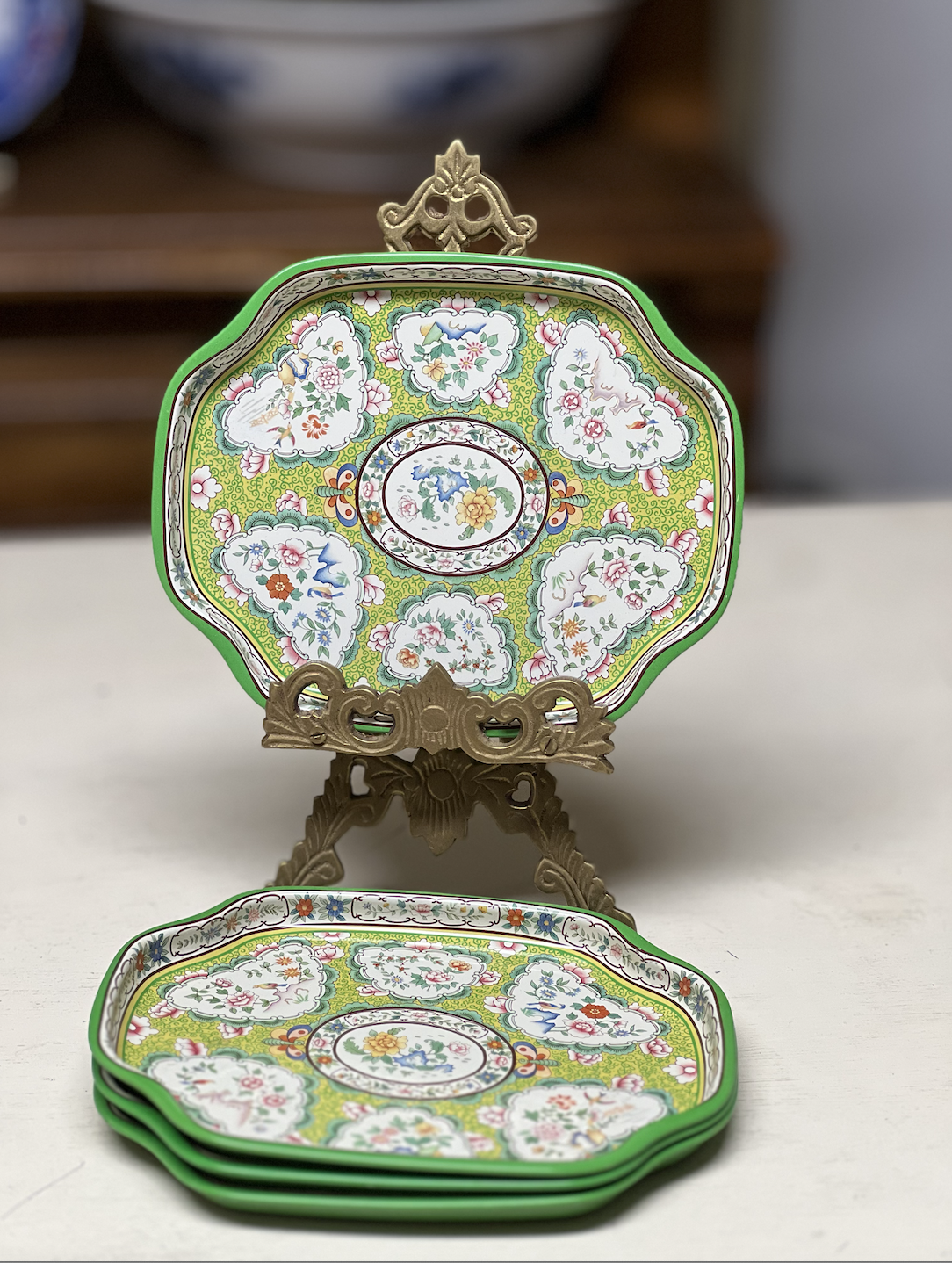
This vintage Baret Ware lithograph tray is a burst of chinoiserie color, with a lime-yellow ground woven in a fine scroll pattern and framed by a bright emerald green rim. White cartouches hold sprays of pink peonies, blossoms, and birds, and a central oval medallion is flanked by a pair of butterflies. The shaped, gently scalloped edge and a delicate floral border make it as charming from the side as from above.
Baret Ware of England made lithographed tin trays and tins in scenes from cottage gardens to Chinese gardens, and their pieces arrived in American shops as giftable packaging in the mid-20th century, ready to be filled with soaps, biscuits, chocolates, teas, and candies. The style has been collected and cherished ever since. Each color in a lithograph goes through its own pass of printing to build up a rich, layered image, and the result here is a tray with real depth and a beautiful gloss.
At 7" by 6", it is the perfect scale for a vanity, a dresser, or an entry table, where it makes a lovely home for rings, keys, perfume bottles, and trinkets. And because the finish is alcohol resistant, it is perfect for a bar cart too, whether it’s holding a bottle of bitters, a set of cocktail picks, a stack of coasters, or a drink or two.
Details
Vintage Baret Ware lithographed metal tray, made in England, chinoiserie design with peonies, birds, and butterflies, lime and emerald green, shaped scalloped edge, alcohol resistant, perfect for vanity or bar cart, 7" x 6", 4 available, sold individually.
Tucked inside every set, a little something for first time Tavola customers — a hand-finished vintage passport notebook. Note the piece, the moment, the person you gave it to. One day these pieces will sit in someone else's hands — and they'll know it came from yours.
NEW!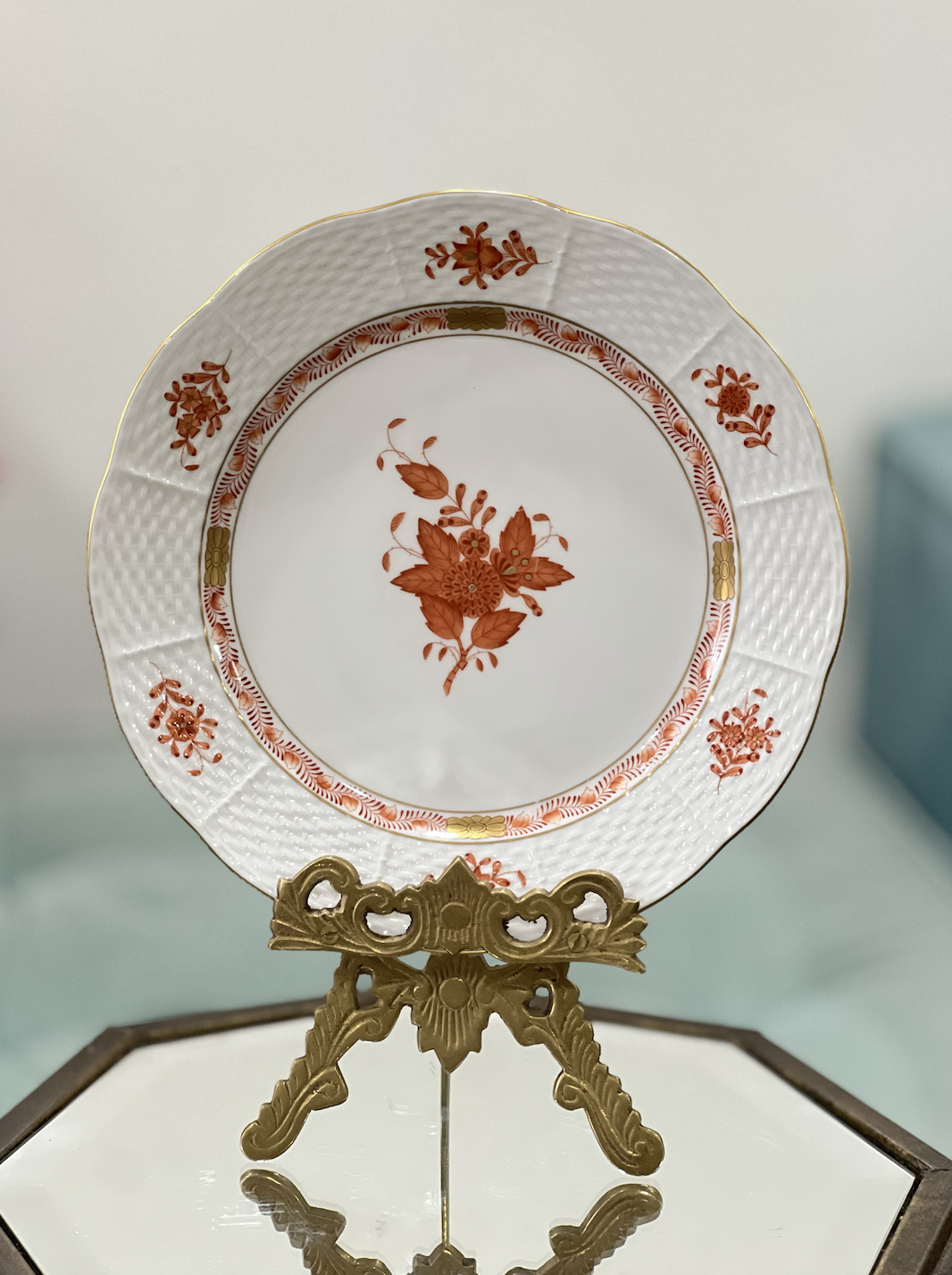
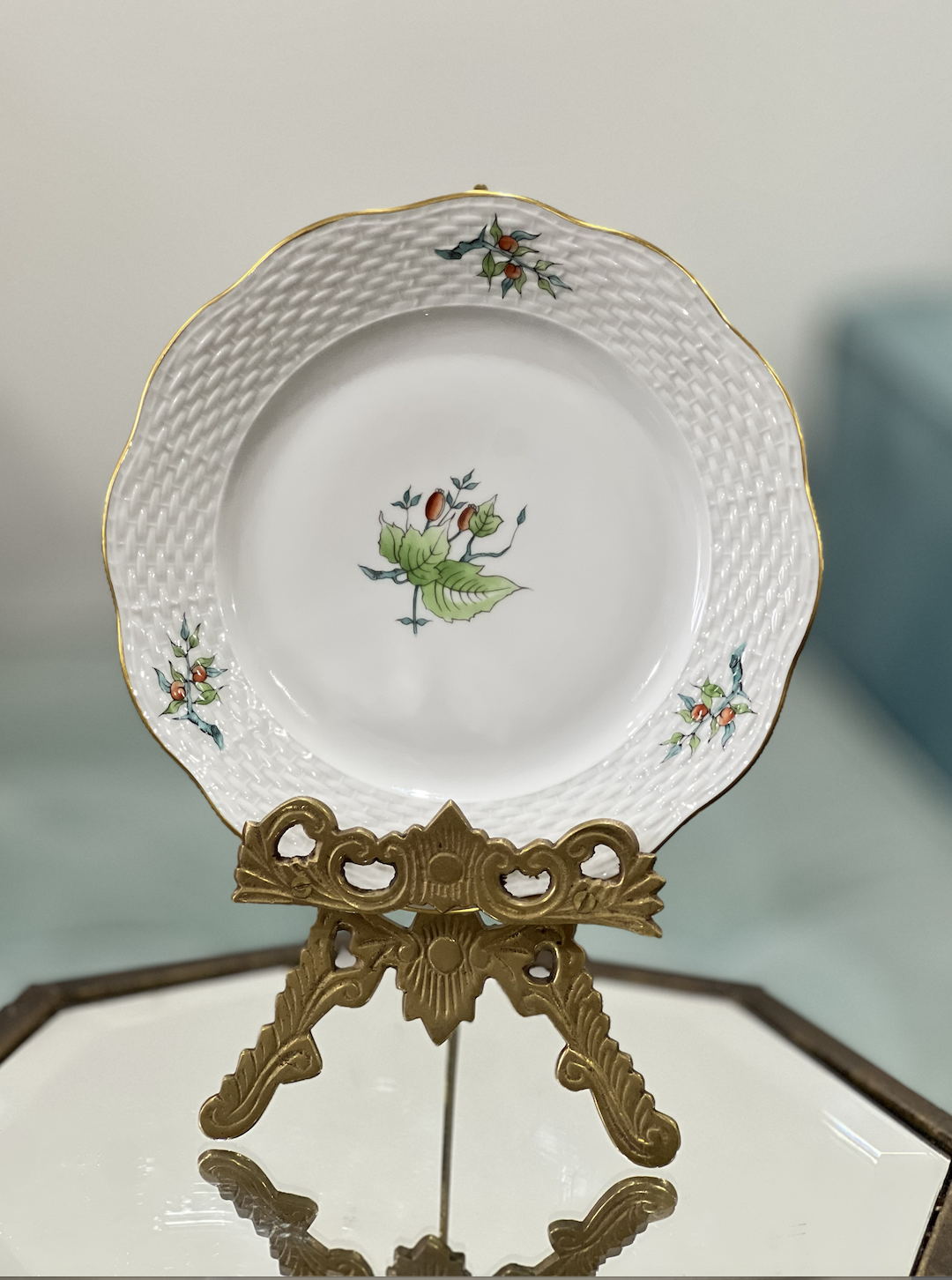
Herend was founded in 1826 in the Hungarian village that gave it its name, and it took its place among Europe's great porcelain houses after 1839, when Mór Fischer began producing replacement pieces for royal families and then designing patterns of his own. Every plate and saucer here is hand-painted and finished with 24k gold gilding, and each carries the raised basket weave that Herend does so beautifully. The technique, called Osier, is a molded basket-weave motif first documented at Meissen in 1736, evoking woven willow branches, and Herend has made it a signature of its own.
Choose from three designs:
Chinese Bouquet Rust (Apponyi Orange), 9" Plate — A single spray of chrysanthemum-style blooms and leaves in warm rust at the center, ringed by a border of tiny leaves and gilt cartouches, with matching floral sprigs scattered across the basket-weave rim. The design that became Apponyi traces to Herend's 1867 showing at the Paris Exposition Universelle, where Hungarian Count Albert Apponyi fell in love with its dominant floral motif. Two available.
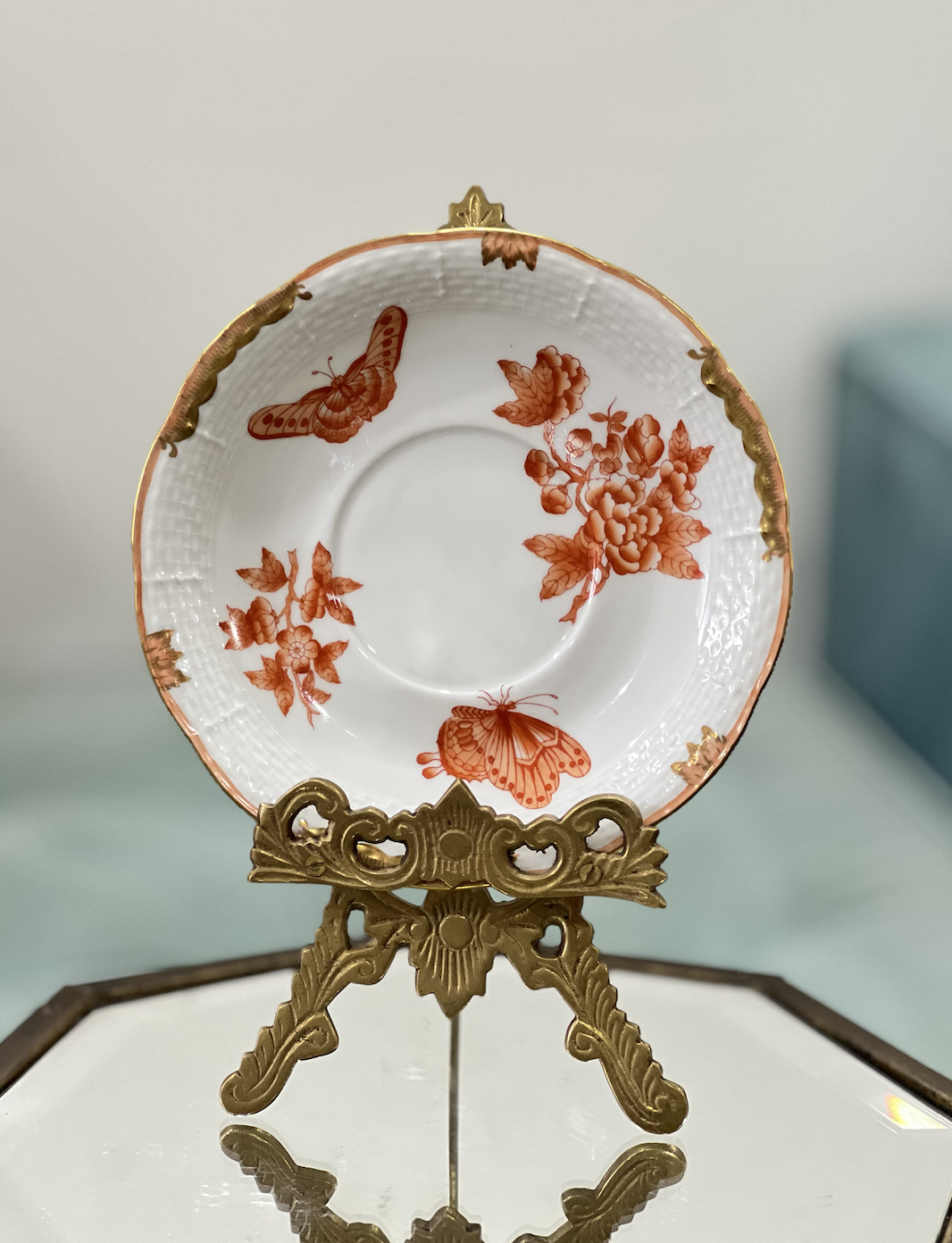
Fortuna Rust, 7" Saucer — Butterflies and flowering branches painted in a single warm rust with gilt accents on the basket-weave rim. Fortuna is a dramatic monochrome take on Herend's Queen Victoria pattern, the design Queen Victoria admired at London's 1851 Great Exhibition, and painting it in one color lets the brushwork rise to the surface with unusual depth and texture. Two available.
Rosehip, 7.5" Plate — A delicate spray of rosehips and green leaves at the center, with matching sprigs on an Osier basket-weave rim and a fine gold edge. A rare, discontinued Herend pattern that is highly collectible. Four available.
Lovely layered on a table, on a plate stand or gathered in a small wall grouping.
Tucked inside every order, a little something for first time Tavola customers — a hand-finished vintage passport notebook. Note the piece, the moment, the person you gave it to. One day these pieces will sit in someone else's hands — and they'll know it came from yours.
Best Sellers

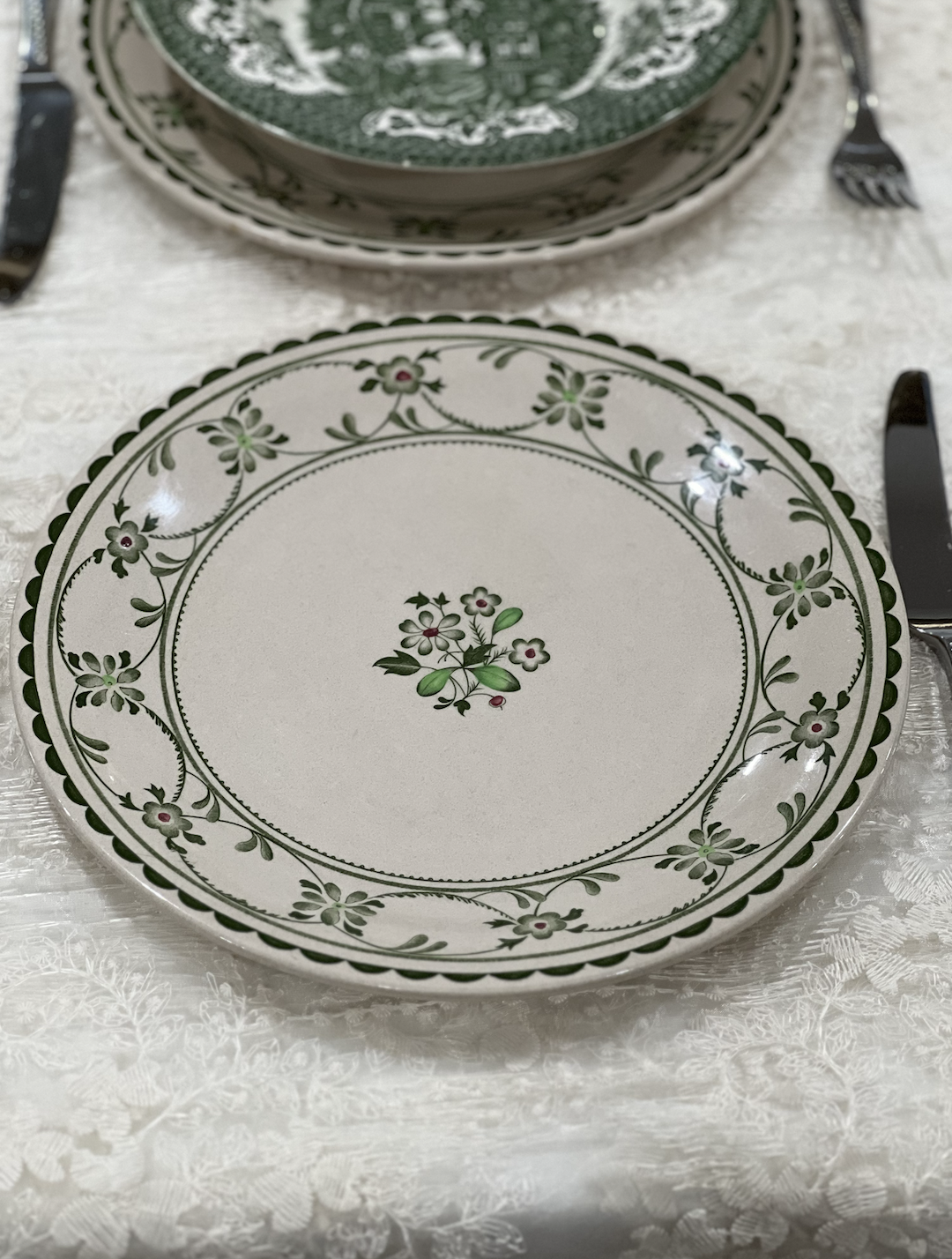
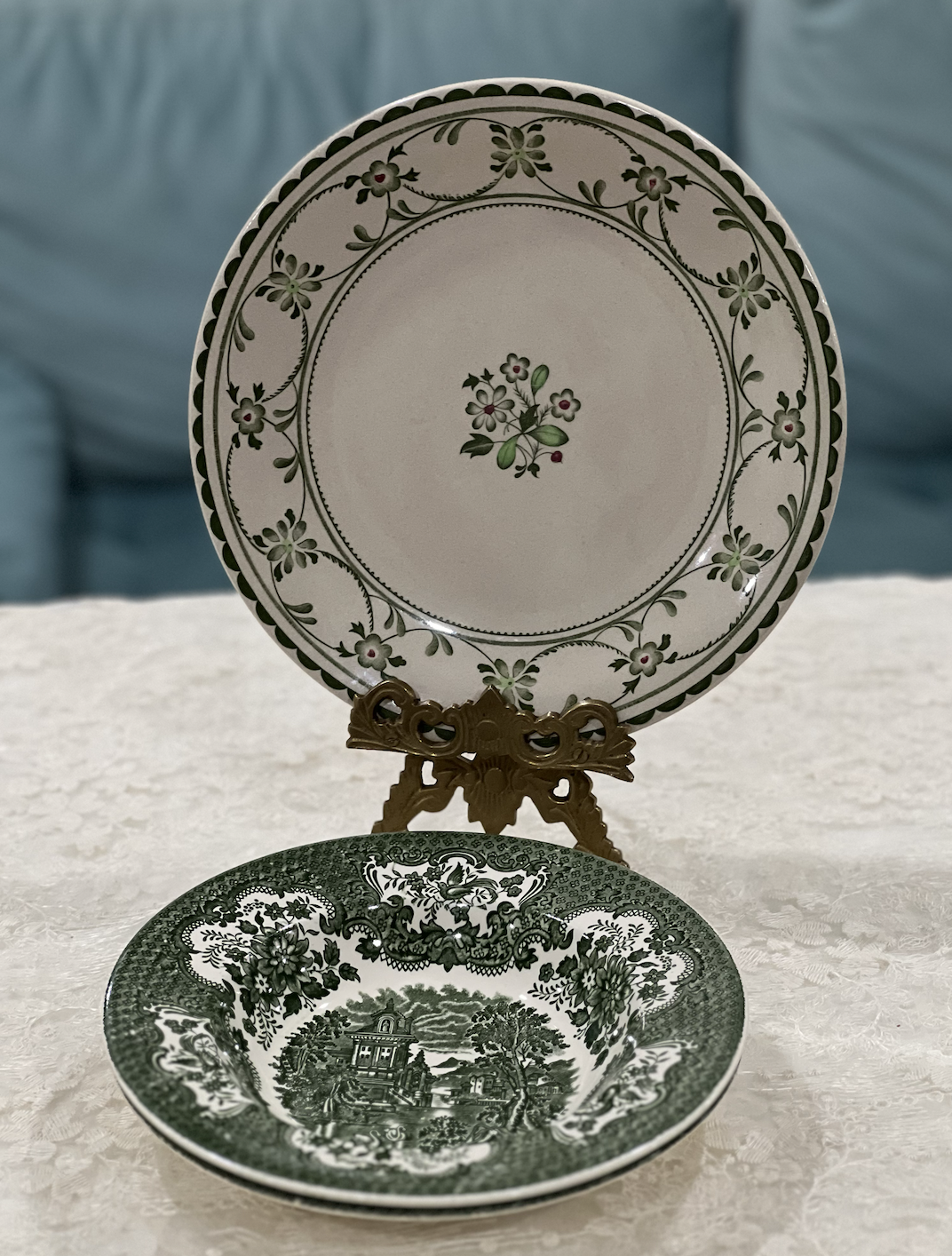
The green transferware pairing you didn't know you needed.
The Provence pattern is understated English transferware at its best — a delicate green floral vine and daisy border with small red accent blooms and a single floral sprig centered in the well. The Old Granite backstamp says it all: Staffordshire, Made in England, genuine hand engraving, all decoration under the glaze and detergent and acid resisting. Built to outlast everything on your table.
The ironstone bowl brings the drama — a rich, fully saturated forest green scenic landscape with swans, an architectural folly among the trees, and a dense border of florals and scrollwork that leaves almost no white ground visible.
Both pieces are good vintage condition. Four of each available, sold individually.
All other items in tablescape pictures sold separately.
Tucked inside every set, a little something for first time Tavola customers — a hand-finished vintage passport notebook. Note the piece, the moment, the person you gave it to. One day these pieces will sit in someone else's hands — and they'll know it came from yours.

The French have always known how to make any plate feel like a moment.
Sarreguemines has been producing majolica in northeastern France since the 1860s, and their fruit and vine series is among the most beloved patterns in French faience collecting. This 7.5" plate is covered in relief-molded grape clusters and vine leaves in warm ochre yellow — a monochromatic composition that earns its keep entirely through texture and form. The paneled border radiates outward to a scalloped rim that gives the plate its shape and its character.
Display it on a stand, layer it into a harvest tablescape, or stack several together on a shelf where the repetition becomes its own kind of statement. Five available, sold individually.
Tucked inside every set, a little something for first time Tavola customers — a hand-finished vintage passport notebook. Note the piece, the moment, the person you gave it to. One day these pieces will sit in someone else's hands — and they'll know it came from yours.
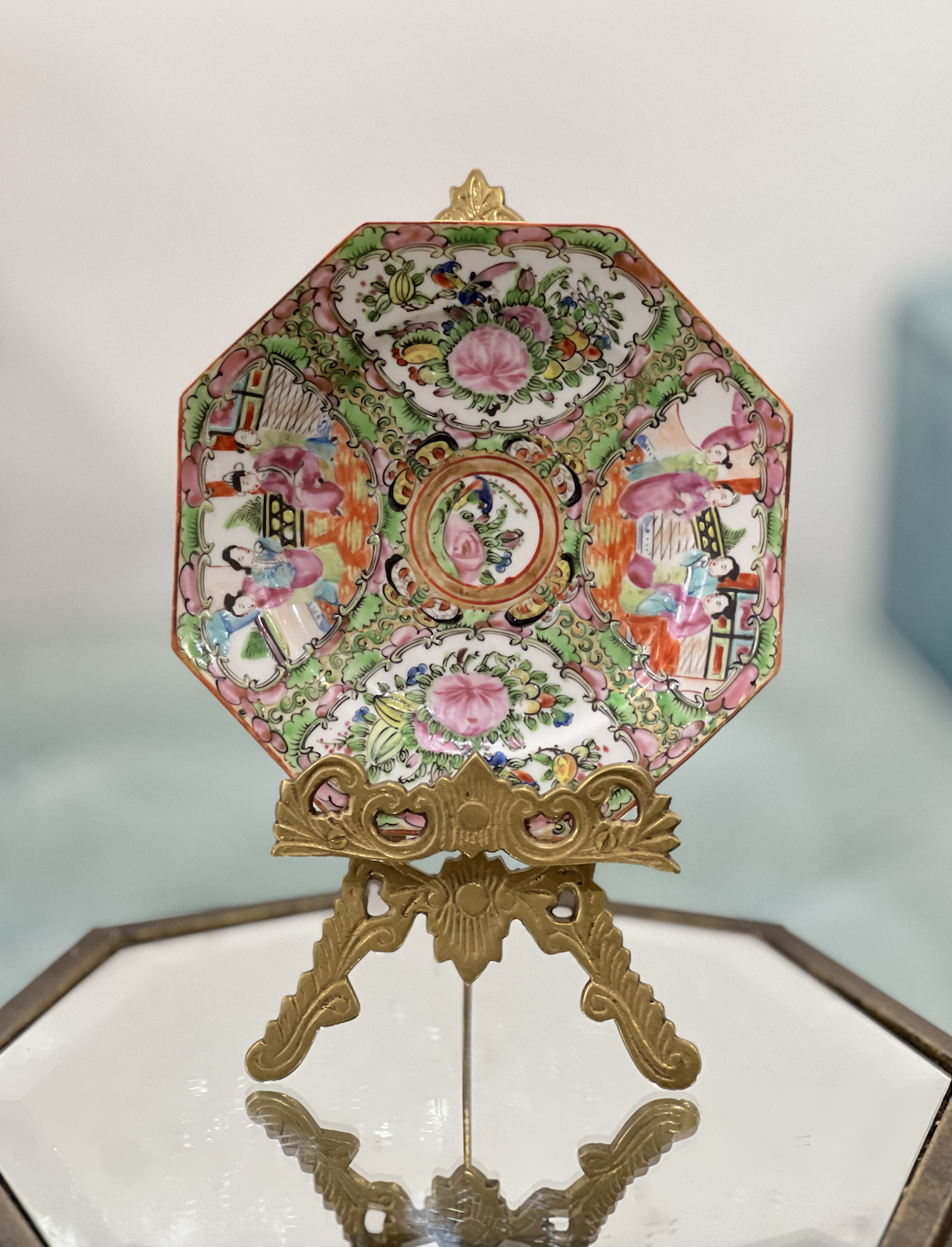
This antique Rose Medallion dish takes an octagonal form with a gilt-edged rim, its surface divided into alternating panels of Chinese figural scenes and lush clusters of peonies, fruit, and foliage. A small central medallion anchors the design, ringed in orange enamel and finished with its own miniature bird-and-floral motif. The dense, layered composition is the hallmark of the pattern — panels of people paired with panels of nature, all wrapped in scrolling green borders.
Rose Medallion belongs to the famille rose family of Chinese export porcelain, developed in the 18th century using an opaque white enamel that let painters build shaded, dimensional color unlike anything achieved before it.Developed around 1720, the famille rose color palette was more chromatically sophisticated than those that preceded it, and because it included white enamel, artists were able to create gradient colors that gave their porcelain decorations a three-dimensional effect. Among the famille rose patterns, Rose Medallion became the most desirable in the West, prized for exactly the mix seen here: figures and nature in equal measure.
Marked "Made in China" on the reverse. Signs of age consistent with antique item.
Tucked inside every set, a little something for first time Tavola customers — a hand-finished vintage passport notebook. Note the piece, the moment, the person you gave it to. One day these pieces will sit in someone else's hands — and they'll know it came from yours.

Blue Danube Japan
Collection
Handpicked pieces that bring memories from tables past.